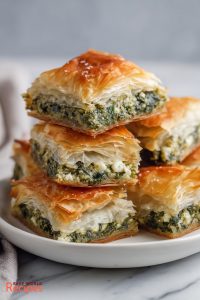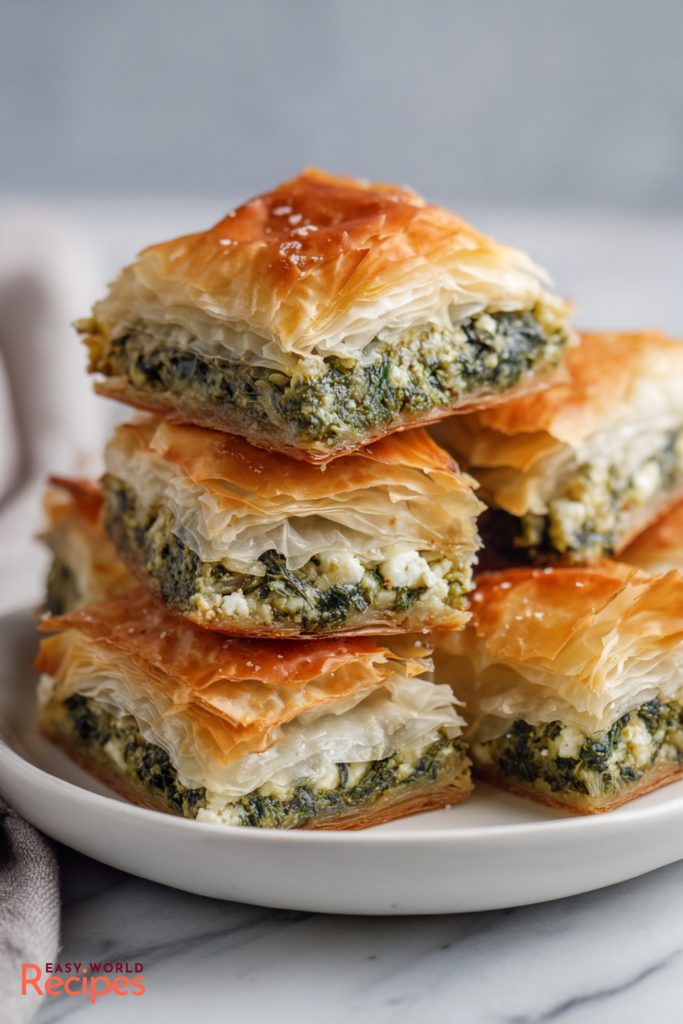
This spanakopita recipe has crisp, flaky phyllo wrapped around a spinach and feta filling with fresh dill, parsley, and mint. It’s a lovely lunch with a salad, and you can cut smaller pieces for a party table.
There’s no need to make your own pastry. Store-bought phyllo works well, and a few torn sheets won’t ruin the pie. The step that matters most is squeezing the spinach properly. Dry filling gives the bottom layers a much better chance to turn crisp.
Below, I’ll show you how to layer the pie, make small triangles instead, and freeze a batch for another day.
What Is Spanakopita?
Spanakopita is a Greek spinach pie, often made with feta, herbs, and thin layers of phyllo pastry. Say it spah-nah-KOH-pee-tah.
It can be baked as one large pie and cut into pieces, or folded into small triangles. This recipe makes a 9×13-inch pie with 12 squares.
You can serve it warm or let it cool a little first. Either way, give it time to rest after baking. Cutting it straight from the oven lets the hot filling spill out and crushes the delicate top layers.
Key Ingredients & Substitutions
Spinach: Frozen chopped spinach is handy here because it’s already trimmed and chopped. Use a 16-ounce package, weighed before thawing and squeezing. If you prefer fresh spinach, start with about 2 pounds, remove tough stems, wilt it, and squeeze it well.
Feta: Buy a block and crumble it yourself. Feta stored in brine usually has a nicer texture than dry, pre-crumbled cheese. Drain it before adding it to the filling.
Phyllo: Use a 16-ounce package of thin phyllo sheets, sometimes labeled #4. Sheet sizes vary, so check the package rather than relying on a fixed sheet count. Phyllo and puff pastry are different; puff pastry won’t give you these thin layers.
Onion or scallions: Either works. Cook them briefly to soften their flavor, then let them cool before mixing with the eggs.
Fresh herbs: Dill and parsley give the filling its familiar flavor. A little mint adds freshness without taking over.
Eggs: Three large eggs help the filling set so you can cut neat squares.
Nutmeg and pepper: A little nutmeg works well with spinach. Add black pepper, then taste the filling for salt before the raw eggs go in.
Olive oil: Use it to cook the onion and brush the pastry. You want a light coating between layers, without puddles.
Fresh Spinach or Frozen? How to Get It Dry
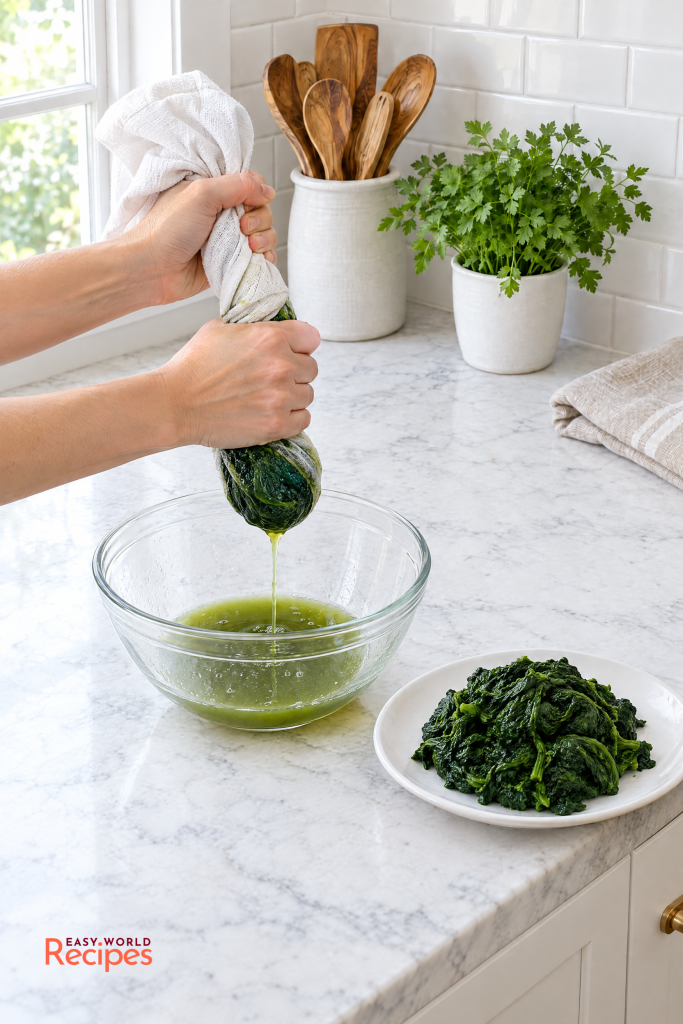
Both work, but frozen spinach saves some prep. Thaw it completely, then put it in a clean kitchen towel over a bowl or sink. Gather the towel and squeeze firmly.
Open the towel, loosen the spinach, and squeeze again. One quick squeeze usually leaves more water than you think. Keep going until very little liquid comes out when you press firmly.
The spinach will look like a small, tightly packed bundle. Pull it apart before mixing so you don’t end up with clumps in the filling.
For fresh spinach, wash it well and wilt it in a large pan in batches. Let it cool in a colander, then squeeze it in a towel and chop it. Don’t add the hot spinach straight to the eggs.
For this recipe, use 16 ounces frozen spinach or about 2 pounds fresh. These are practical alternatives, rather than an exact weight conversion. Fresh bunches vary in their stems and water content, so the amount left after draining will vary too.

How to Work With Phyllo Without Tearing It
Thaw frozen phyllo in its sealed packaging in the refrigerator overnight, following the package directions. If the package says to bring it to room temperature before opening, allow time for that too. Unrolling partly frozen sheets is an easy way to tear them.
Set out your filling, oil, pastry brush, and a 9×13-inch baking pan before opening the dough. A metal pan is useful if you want a crisp base.
Unroll the sheets and cover the stack with plastic wrap, then a slightly damp towel. Lift the cover only long enough to take the next sheet. The towel should help keep the dough from drying out without making it wet.
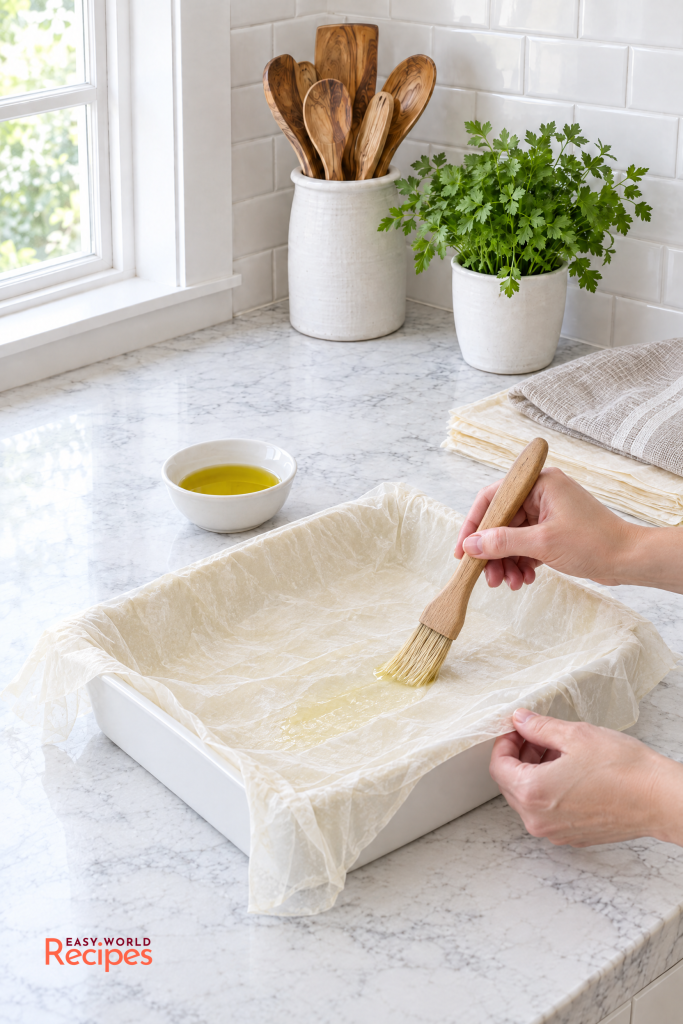
Brush each layer lightly with olive oil. Gentle strokes work better than dragging a dry brush across the pastry.
If a sheet tears, lay the pieces together in an inside layer. They’ll still bake into the pie. Save a couple of whole sheets for the top, where they’ll be most visible.
This is also useful when working with phyllo for baklava: keep the stack covered, work steadily, and don’t worry about every little tear.
Butter or Olive Oil?
I use olive oil here. It suits the spinach, herbs, and salty feta, and helps the thin pastry layers turn crisp.
Melted butter also works if you prefer its richer flavor. Replace the brushing oil with the same volume of melted butter, but keep the olive oil used to cook the onion.
Whichever you choose, brush lightly and evenly. Dry patches can bake up floury, while too much fat leaves the bottom greasy.
How to Make Spanakopita, Step by Step
1. Prepare the Filling
Thaw and squeeze the spinach, or wilt, cool, squeeze, and chop fresh spinach.
Heat 2 tablespoons olive oil in a skillet. Cook the chopped onion or scallions for about 5 minutes, until softened. Set aside to cool.
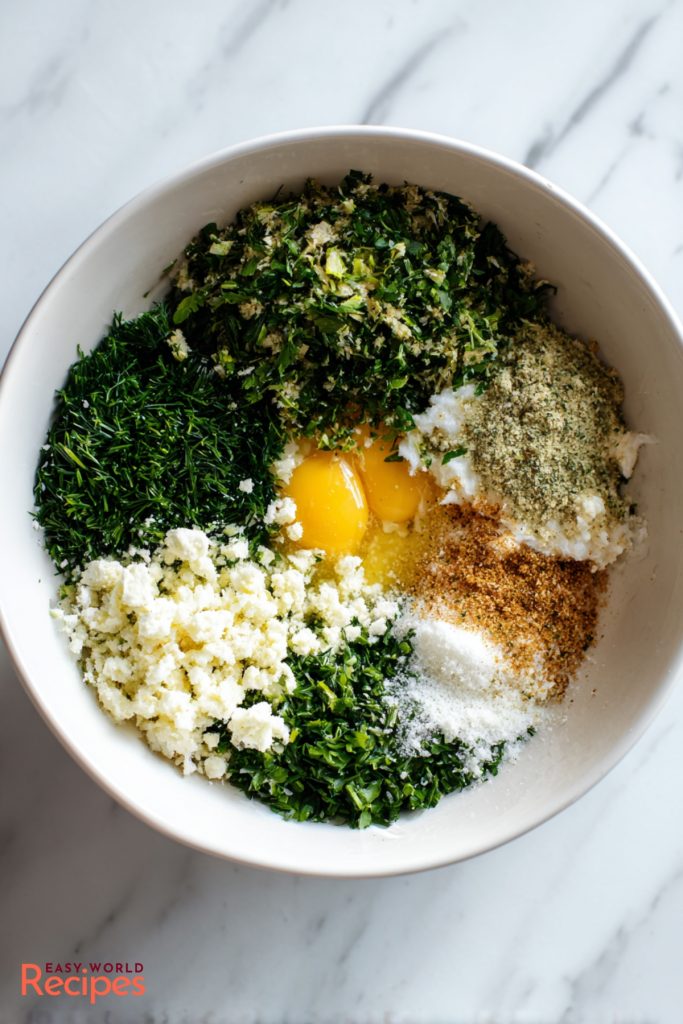
Mix the spinach, crumbled feta, cooled onion, dill, parsley, mint, nutmeg, and pepper in a large bowl. Taste now and add a little salt only if needed. Then stir in the beaten eggs.
2. Get the Pan and Phyllo Ready
Heat the oven to 350°F (175°C) with a rack in the lower third.
Lightly oil a 9×13-inch pan. Open the thawed phyllo and keep it covered while you work. Divide it into two roughly equal stacks: one for the base and one for the top.
If your sheets are much larger than the pan, trim them to fit. Use clean offcuts to patch inside layers.
3. Layer the Pie
Lay one sheet in the pan and brush it lightly with olive oil. Repeat with the first half of the phyllo, keeping the unused sheets covered.
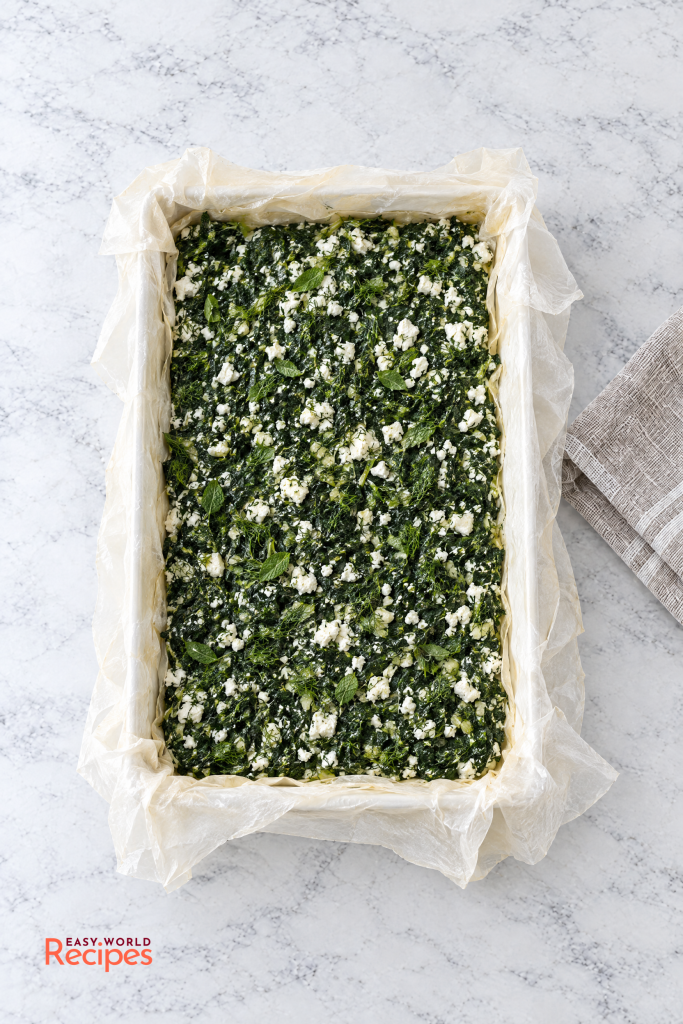
A little overhang is fine. Spread the spinach filling evenly over the base, right into the corners, without pressing it down hard.
Add the remaining phyllo a sheet at a time, brushing each layer. Fold or tuck in the loose edges and brush the top and border.
4. Score and Bake
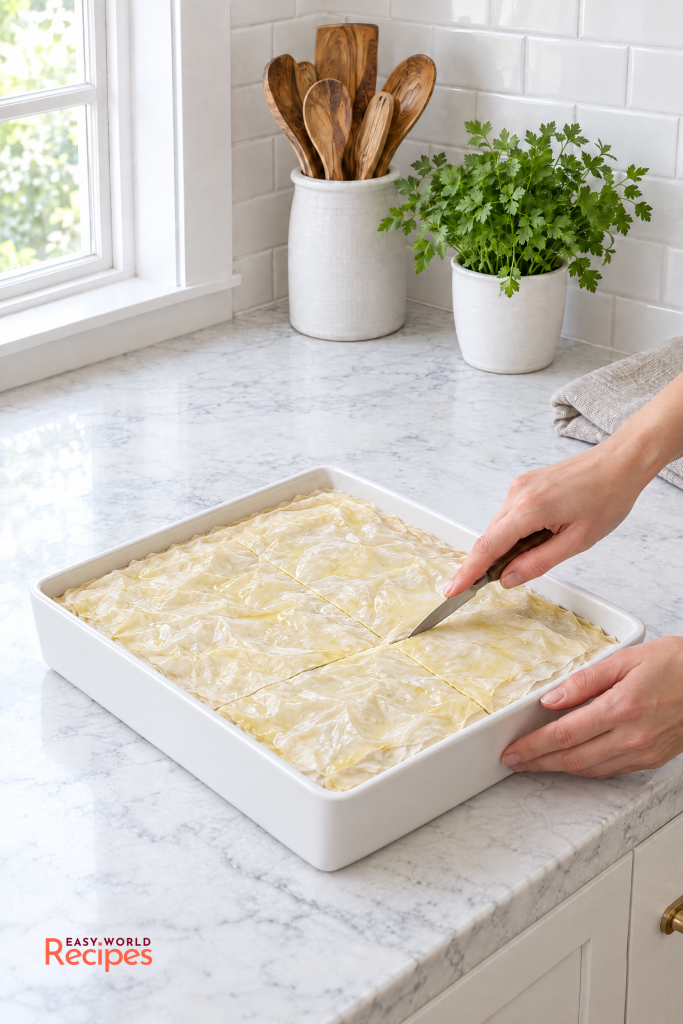
Use a sharp knife to score the top pastry into 12 squares. Cut through the upper sheets without slicing through the bottom crust.
With damp fingertips, flick just a few drops of water over the top. It should not look wet.
Bake for 45–55 minutes, until deeply golden and crisp, with the filling set. If the top browns too quickly, cover it loosely with foil and keep baking.
5. Rest Before Cutting
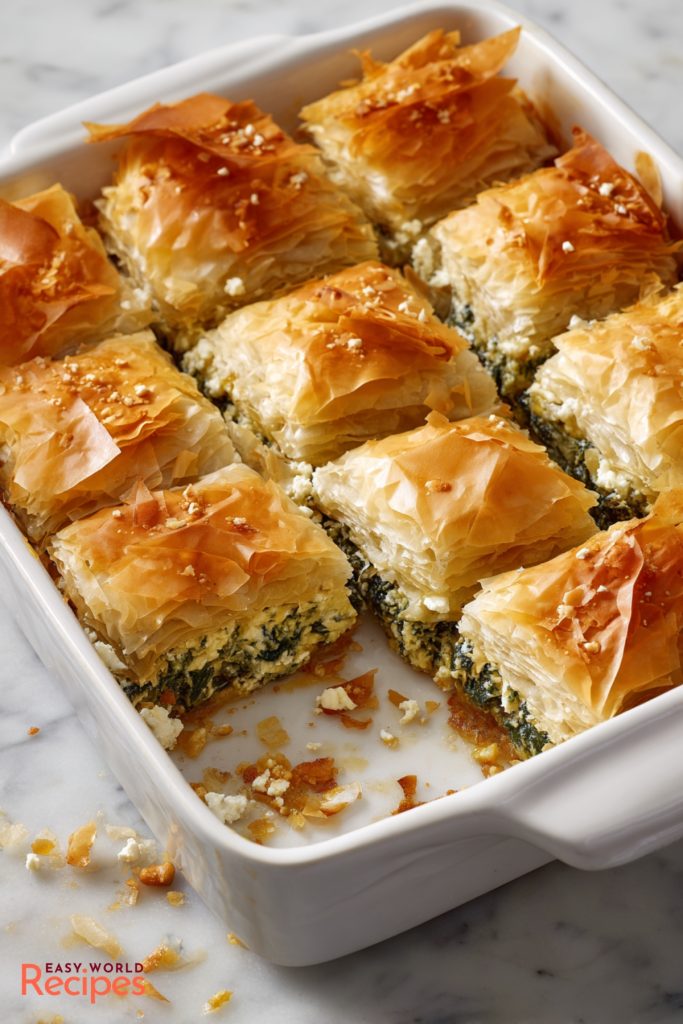
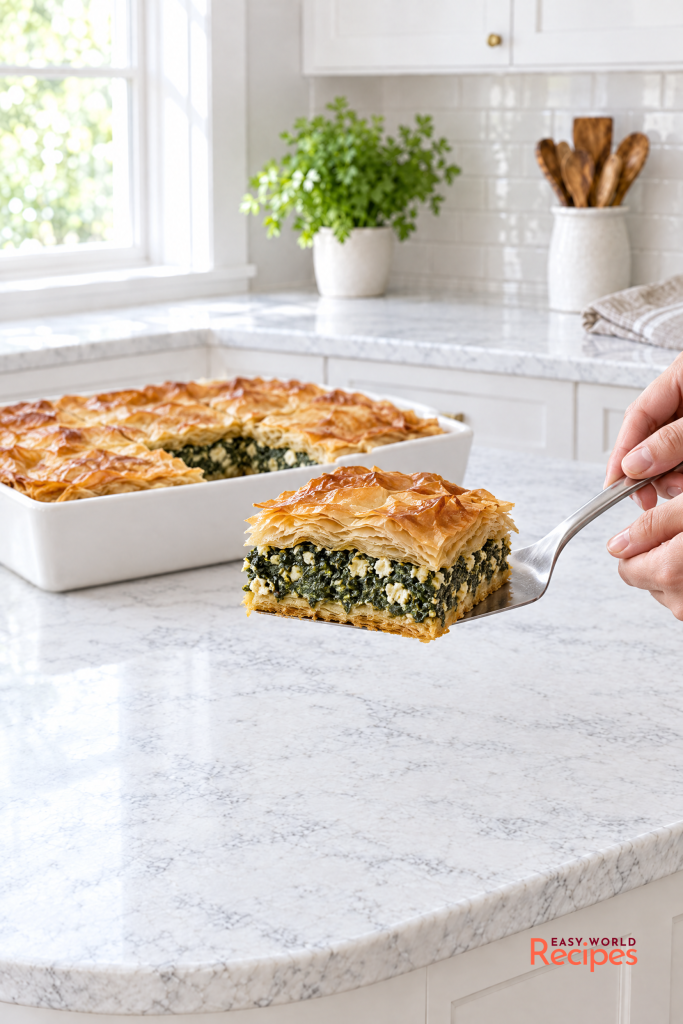
Let the pie rest for 15–20 minutes. This gives the filling time to settle and makes the squares easier to lift.
Cut through the scored lines and the bottom crust. Serve warm, or let the pieces cool a little more before serving.
How to Stop Spanakopita Getting a Soggy Bottom
Wet spinach is the first thing to check, but a few other small steps help too:
- Squeeze more than once. Spinach can look drained while still holding plenty of water.
- Cool the cooked filling ingredients. Hot spinach or onion adds steam while you’re building the pie.
- Use a metal pan when possible. It usually browns the base more readily than a thick ceramic dish.
- Bake in the lower third of the oven. This gives the bottom more direct heat.
- Score the top before baking. The cuts make serving easier and give steam places to escape.
- Rest uncovered. Covering a hot pie traps steam and softens the pastry.
For a metal pan, you can also preheat a sturdy baking sheet in the oven and set the pan on it. Avoid putting a cold glass or ceramic dish onto a hot tray.
Some cooks add a tablespoon of fine semolina or cooked rice to absorb a little extra moisture. Treat that as a small backup, not a fix for dripping spinach.
Make Spanakopita Triangles Instead
Small triangles, called spanakopitakia, are handy for parties or a freezer batch.
Use the same filling. Lay down a phyllo sheet, brush lightly with oil, and add a second sheet. Brush again, then cut lengthwise into strips about 3–4 inches wide.
Put a small spoonful of filling near one end. Fold one corner across to make a triangle, then keep folding the triangle along the strip, like folding a flag. Keep the filling tucked inside without packing it too tightly.
Place the triangles seam-side down on a lined baking sheet. Brush the tops and bake at 350°F (175°C) for about 25–35 minutes, until golden and crisp.
Expect roughly 40 small triangles, depending on the sheet size and how much filling you use. Divide the filling into small portions as you work so the final triangles aren’t left mostly empty.
Freeze them unbaked in a single layer, then pack them into a container once firm. You can bake just a few at a time.
Make-Ahead, Storage, and Freezing
You can assemble the pie up to 24 hours ahead. Cover and refrigerate it, then uncover before baking. A chilled pie may need a few extra minutes in the oven.
For the crispest result, another option is to prepare the filling a day ahead and layer the phyllo shortly before baking. Keep the filling covered in the refrigerator.
Refrigerate leftovers within 2 hours. Store covered for 3–4 days.
Freezing Before Baking
Assemble and score the pie in a freezer-to-oven-safe metal or foil pan. Wrap it well and freeze for up to 2 months for best quality.
Remove the wrapping and bake straight from frozen at 350°F (175°C). Allow roughly 15–25 extra minutes, checking that the middle is cooked through as well as the top being golden. Cover loosely with foil if needed.
Freezing After Baking
Let the pie cool, then wrap individual portions and freeze for up to 3 months. The pastry may be a little less crisp than a freshly baked pie, but the smaller portions are easy to reheat.
Reheating Without Softening the Pastry
Place chilled squares on a baking sheet in a 350°F (175°C) oven for about 15–20 minutes, until hot in the center and crisp outside. Larger pieces take longer.
You can also use an air fryer at about 325°F (160°C), checking after 6–8 minutes and continuing until heated through.
Frozen portions need longer in the oven, often 25–35 minutes depending on their size. Cover loosely if the top gets dark before the middle is hot.
The microwave works if you’re in a hurry, but it softens the phyllo.
What to Serve With Spanakopita
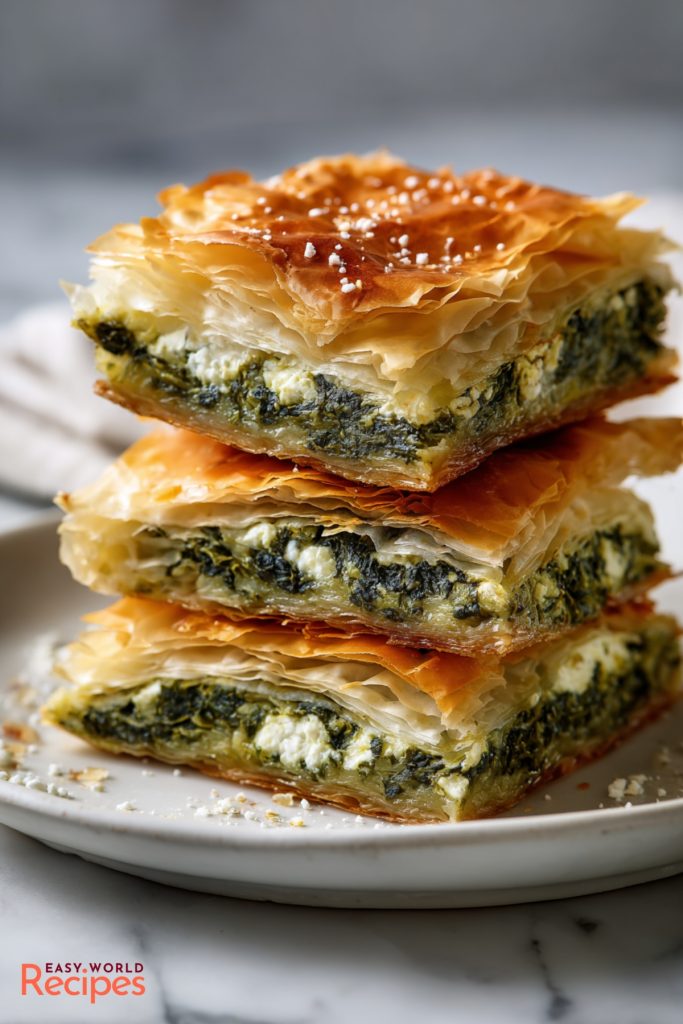
For lunch, serve a warm square with a traditional Greek salad. The tomatoes and cucumber are a nice match for the salty feta filling.
Add homemade tzatziki on the side for dipping. Keep it beside the pie rather than spreading it over the pastry, so the top stays crisp.
For a bigger meal or a holiday table, serve smaller squares alongside Greek roast lamb. It also makes a good side for a simple bowl of soup.
If you’re serving it at a party, cut the squares into smaller pieces after the pie has rested. They’re easier to pick up, and the filling is less likely to spill.
Spanakopita, Spanakotiropita, and Other Greek Pies
Spanakopita means spinach pie. You may also see the name spanakotiropita, which makes the cheese part clear. In everyday use, spinach-and-feta pie is commonly called spanakopita too, so both names make sense here.
Cheese-free versions exist as well, including versions made for fasting that leave out the eggs.
If you enjoy this pie, try Greek cheese pie, tiropita, for a filling centered on cheese, or zucchini pie, kolokithopita, for another vegetable option.
Cretan boureki combines potatoes and zucchini, while Greek meat pie with phyllo is a good choice when you want a meat filling.
FAQs
Can I use frozen spinach?
Yes. This recipe uses one 16-ounce package of frozen chopped spinach, weighed before thawing and draining. Thaw it fully and squeeze it firmly in a clean towel. Pull the squeezed spinach apart before mixing it with the other ingredients.
What kind of feta should I use?
A block of feta in brine is a good choice. Drain it, then crumble it yourself. Sheep’s milk feta or a sheep-and-goat milk blend works well. Taste the filling before adding the eggs to see whether it needs any extra salt.
Can I make spanakopita ahead of time?
Yes. Assemble it, cover, and refrigerate for up to 24 hours before baking. Or make the filling ahead and add the phyllo on the day you want to bake it. Keep the filling chilled until you’re ready to use it.
Can I freeze spanakopita?
Yes, before or after baking. For the best pastry texture, freeze the assembled unbaked pie and bake it from frozen. Cooked slices also freeze well for easy lunches. See the freezing section above for times and instructions.
Can I add other herbs or greens?
Yes. This version already includes dill, parsley, and mint. You can replace some spinach with chopped chard leaves or other tender cooking greens. Remove tough stems, cook the greens if needed, and squeeze them well so you don’t add extra moisture.
Why is my spanakopita soggy on the bottom?
The filling was probably too wet, or the base needed more time to bake. Squeeze the spinach several times, use the lower oven rack, and let the finished pie rest uncovered. A metal baking pan can also help the bottom brown.
Do you use butter or olive oil for spanakopita?
I use olive oil in this recipe. It works well with the spinach and herbs and helps the phyllo turn crisp. Melted butter is also an option if you prefer its flavor. Use it in place of the brushing oil.
What is the difference between spanakopita and spanakotiropita?
Spanakopita means spinach pie, while spanakotiropita names both spinach and cheese. Many people use spanakopita for the feta version too. You’ll also find cheese-free spinach pies, so check the filling rather than relying only on the name.
How do you reheat spanakopita and keep it crispy?
Reheat it uncovered in the oven or an air fryer. For chilled squares, start with about 15–20 minutes at 350°F (175°C) in the oven, and check that the center is hot. Avoid the microwave when you want crisp pastry.
Is spanakopita served hot or cold?
You can enjoy it warm, cool, or straight from the fridge. For warm servings, let it rest for 15–20 minutes after baking so the filling holds together. If serving at room temperature, put leftovers in the refrigerator within 2 hours.
How much fresh spinach do I need instead of frozen?
For this recipe, use about 2 pounds of fresh spinach in place of the 16-ounce frozen package. Trim, wilt, cool, and squeeze it before mixing. The weights aren’t an exact conversion because fresh spinach varies in stem weight and how much water it releases.
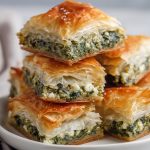
Spanakopita (Greek Spinach and Feta Pie)
- Total Time: 1 hour 40 minutes
- Yield: 12 squares 1x
Description
Crisp layers of phyllo filled with spinach, feta, dill, parsley, and mint. This Greek spinach pie makes 12 squares and works well for lunch, a side dish, or a party table.
Ingredients
- 16 ounces (454 g) frozen chopped spinach, thawed and squeezed very dry; or about 2 pounds (900 g) fresh spinach, trimmed, wilted, cooled, squeezed, and chopped
- 2 tablespoons olive oil, for cooking the onion
- 1 small onion or 4 scallions, finely chopped
- 10 ounces (280 g) feta cheese, drained and crumbled
- 3 large eggs, beaten
- 2 tablespoons chopped fresh dill
- 2 tablespoons chopped fresh parsley
- 2 tablespoons chopped fresh mint
- 1/4 teaspoon ground nutmeg
- 1/4 teaspoon black pepper
- Salt, only if needed
- 1 package (16 ounces / 454 g) thin phyllo dough, thawed according to the package directions
- 3/4–1 cup (180-240 ml) extra virgin olive oil, for brushing the pan and pastry, as needed
Instructions
- Prepare the spinach. Squeeze the thawed spinach firmly in a clean kitchen towel. Loosen it and squeeze again until very little liquid comes out. If using fresh spinach, wilt it in batches, cool, squeeze, and chop.
- Cook the onion. Heat 2 tablespoons olive oil in a skillet over medium heat. Add the onion or scallions and cook for about 5 minutes, until soft. Let cool.
- Mix the filling. Combine the spinach, cooled onion, feta, dill, parsley, mint, nutmeg, and pepper. Taste and add salt only if needed. Stir in the beaten eggs after tasting.
- Prepare the oven and pan. Heat the oven to 350°F (175°C), with a rack in the lower third. Lightly brush a 9×13-inch pan with some of the brushing oil.
- Prepare the phyllo. Unroll the thawed sheets. Keep the stack covered with plastic wrap and a slightly damp towel while working. Divide the sheets into two roughly equal portions. Trim oversized sheets to fit the pan, using offcuts to patch inside layers.
- Build the base. Lay a phyllo sheet in the pan and brush lightly with olive oil. Continue with the first half of the sheets, brushing each layer. A little overhang around the sides is fine.
- Fill and cover. Spread the spinach mixture evenly over the base. Layer the remaining phyllo over it, brushing each sheet. Tuck or fold in the edges and brush the top and border. Use enough oil to coat the sheets lightly, without leaving puddles.
- Score the top. Cut the upper layers into 12 squares without cutting through the bottom crust. Flick a few drops of water over the top with damp fingertips.
- Bake. Bake for 45–55 minutes, until deeply golden and crisp and the filling is set. Cover loosely with foil if the top browns before the pie is ready.
- Rest and serve. Rest uncovered for 15–20 minutes. Cut through the scored lines and bottom crust, then serve.
Notes
- Thawing: Follow the phyllo package instructions. An overnight refrigerator thaw usually works well; some brands also need time at room temperature before opening.
- Sheet size: Brands contain different sheet sizes and counts. Use roughly half the package below the filling and half above, trimming large sheets as needed.
- Butter option: Replace the brushing oil with the same volume of melted butter if preferred. Keep the 2 tablespoons olive oil used for the onion.
- Salt: Feta varies in saltiness. Taste the spinach-and-cheese mixture before adding the raw eggs.
- Make ahead: Cover the assembled pie and refrigerate for up to 24 hours. A chilled pie may need extra baking time.
- Freeze unbaked: Assemble in a freezer-to-oven-safe metal or foil pan, wrap, and freeze for up to 2 months. Unwrap and bake from frozen, allowing roughly 15–25 extra minutes or until cooked through.
- Leftovers: Refrigerate within 2 hours and keep for 3–4 days. Reheat uncovered in the oven until hot throughout.
- Scaling: For a double batch, use two 9×13-inch pans so the filling depth stays the same.
- Prep Time: 30 minutes
- Cook Time: 50 minutes
- Category: Main dish
- Cuisine: Greek
Nutrition
- Calories: 280
- Fat: 19g
- Carbohydrates: 18g
- Fiber: 2g
- Protein: 8g
Nutrition information
This website gives estimated nutritional information, which might change depending on the ingredients used.