Description
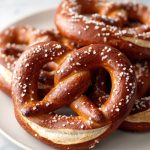
This Bavarian Soft Pretzels (Laugenbrezel) recipe makes eight chewy pretzels with thick soft bellies, thin arms, pretzel salt, and three choices for the alkaline bath.
Ingredients
Pretzel Dough
- 4 cups (500 g) bread flour
- 1 1/4 cups (300 ml) warm water, about 100°F to 110°F (38°C to 43°C)
- 2 1/4 teaspoons (7 g) active dry yeast
- 1 tablespoon (20 g) barley malt syrup or brown sugar
- 2 teaspoons (12 g) fine salt
- 3 tablespoons (42 g) unsalted butter, softened
- 2 tablespoons (about 20 g) pretzel salt, coarse kosher salt, or flaky sea salt
Option 1: Regular Baking Soda Bath
- 8 cups (1.9 liters) water
- 1/2 cup (120 g) baking soda
Option 2: Baked Baking Soda Bath
- 8 cups (1.9 liters) water
- 1/2 cup baked baking soda
Option 3: Traditional 4% Food-Grade Lye Bath
- 960 g cold water
- 40 g food-grade sodium hydroxide
Instructions
- Wake up the yeast. Stir the warm water, barley malt syrup, and yeast together in a large mixing bowl, then leave them for 5 to 10 minutes. You should see some foam or bubbles forming on top, which tells you the yeast is active. If nothing happens, start again with fresh yeast before adding your flour because dead yeast will leave the pretzels heavy.
- Mix the pretzel dough. Add the bread flour, fine salt, and softened butter, then mix until the loose flour disappears and a firm dough forms. It may look a little rough at first, and that’s normal because pretzel dough is much firmer than sticky sandwich bread dough. Don’t pour in extra water unless the mixture truly won’t come together after several minutes of mixing.
- Knead until smooth. Knead with a dough hook for 6 to 8 minutes or by hand for 8 to 10 minutes. The rough dough should become smooth, stretchy, and springy, without feeling wet against your fingers. Press it lightly with a fingertip; when the dent slowly begins to rise again, you’ve built enough strength for the pretzels to hold their shape.
- Let the dough rise. Place the dough in a lightly greased bowl, cover it, and leave it somewhere warm for about 60 minutes. You’re looking for dough that’s clearly puffy and close to twice its original size, rather than watching the clock alone. A cool kitchen can add 20 or 30 minutes, so give the yeast more time instead of moving ahead with dense dough.
- Divide and start shaping. Turn the dough onto a clean work surface and divide it into 8 equal pieces, about 105 to 110 grams each. Roll each piece into a short log, then keep the unused pieces covered while you work. This stops a dry skin from forming, which can make the long ropes harder to roll and cause cracks later.
- Roll the Bavarian shape. Roll one piece into a 24- to 28-inch rope, leaving a thick section in the middle and making both ends thin. If the rope springs back and refuses to grow longer, cover it and let it rest for 5 minutes before continuing. The thick middle becomes the soft belly, while the thin arms become darker and chewier in the oven.
- Form each pretzel. Bend the rope into a wide U, cross the thin ends twice, then fold them down and press them onto the lower curve. Leave plenty of open space between the arms because the dough will expand during baking. Press the ends firmly enough that they stay attached, but don’t flatten the thick belly while you’re working.
- Chill before dipping. Arrange the eight shaped pretzels on lined baking sheets and refrigerate them uncovered for 20 to 30 minutes. They’ll feel firmer and slightly drier when they’re ready, which makes them far easier to move into the alkaline bath. Warm pretzel dough can stretch badly during dipping, so this short chilling step is worth the wait.
- Prepare your chosen bath. For either baking soda method, bring 8 cups water to a gentle boil and carefully add ½ cup regular or baked baking soda; add it slowly because it may foam. For the lye option, wear gloves and eye protection and follow your food-grade product’s directions, adding 40 g lye to 960 g cold water rather than pouring water onto lye. Never use drain cleaner, aluminum equipment, or a lye product that isn’t sold for food preparation.
- Dip the chilled pretzels. Place each pretzel into the baking soda bath for 20 to 30 seconds, then lift it out with a nonreactive slotted utensil and let the extra liquid drain. If you’re using lye, don’t boil the solution; follow the dipping directions supplied with your food-grade lye while wearing your protective equipment. Place each dipped pretzel back onto its lined baking sheet without letting the pieces touch.
- Slash and salt. Cut one shallow line, about ¼ inch deep, across the thick belly using a razor, bread lame, or very sharp knife. You want a neat opening through the surface rather than a deep cut through the whole center. Sprinkle on pretzel salt immediately while the surface is damp so the grains stick instead of falling off before the tray reaches the oven.
- Bake until mahogany brown. Bake at 425°F (220°C) for 14 to 17 minutes, until the crust is deeply browned and the belly slash has opened into a lighter strip. Don’t pull the pretzels when they’re merely pale gold because much of their flavor comes from that dark surface. Let them cool on a rack for at least 10 minutes so the soft interior can finish setting before you tear one open.
Notes
Bread flour makes a chewier pretzel, but all-purpose flour works if that’s what you have at home.
Barley malt syrup adds a bakery-style malt note, while brown sugar makes an easy substitute without changing the method.
For baked baking soda, heat regular baking soda at 275°F (135°C) for one hour, cool it, and handle the finished powder with care because it’s more alkaline than ordinary baking soda.
Food-grade lye gives the darkest traditional crust, but it isn’t required for good pretzels. Wear gloves and eye protection, use suitable nonreactive equipment, and always follow the safety directions supplied with your product.
Proper pretzel salt gives the best white crunchy grains. Coarse kosher salt or flaky sea salt works when pretzel salt isn’t available.
To revive a day-old pretzel, spritz it lightly with water and heat it for about 5 minutes at 350°F (175°C). The crust becomes pleasantly chewy again while the middle warms and softens.
- Prep Time: 35 minutes
- Cook Time: 17 minutes
- Category: Bread, Snack
- Cuisine: German, Bavarian
Nutrition
- Calories: 300
- Sugar: 2 g
- Sodium: 780 mg
- Fat: 6 g
- Saturated Fat: 3 g
- Carbohydrates: 53 g
- Fiber: 2 g
- Protein: 9 g